Synchrony cascades across system boundaries
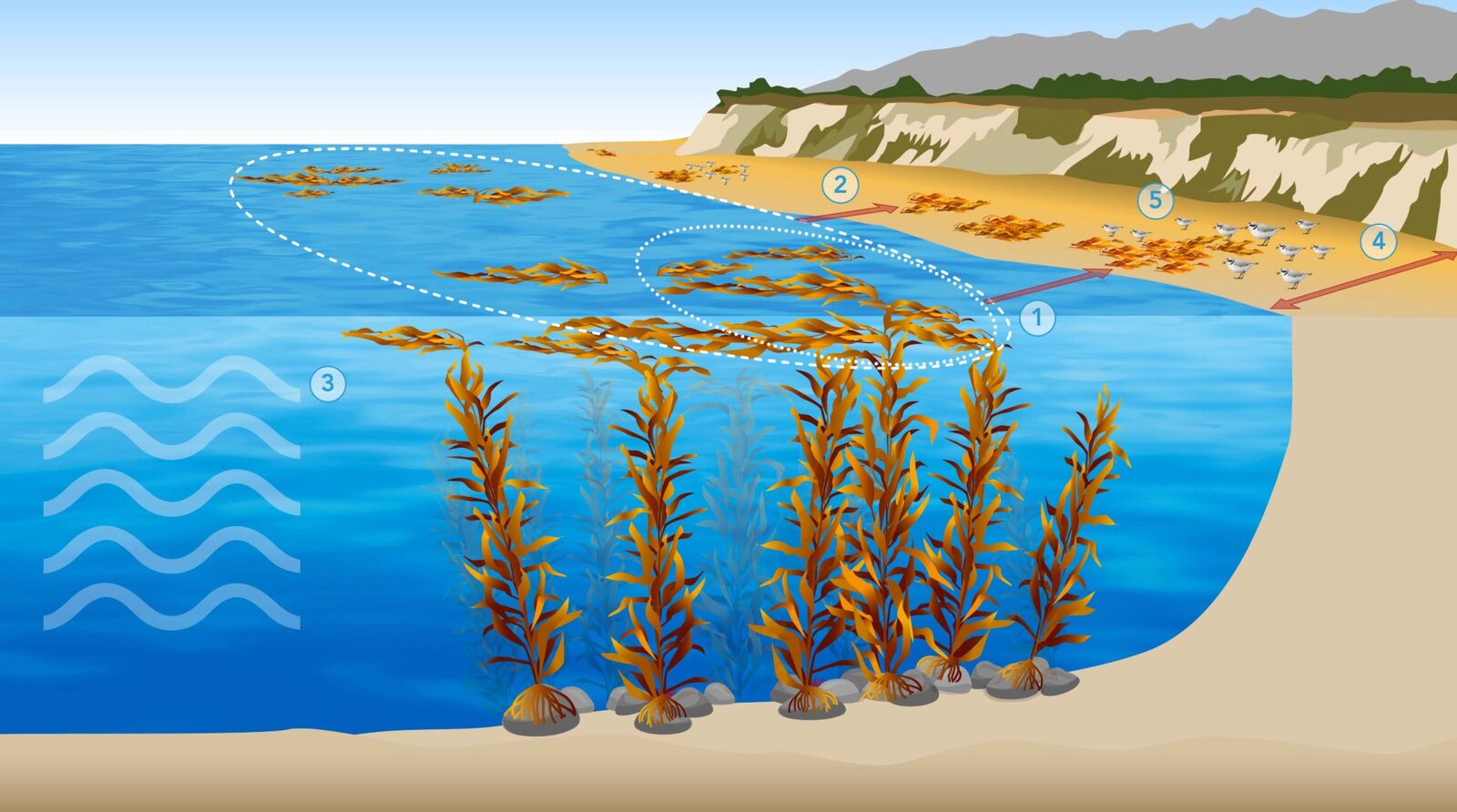
Spatial synchrony in the environmental drivers of population dynamics can induce synchrony in the populations, through a process called the Moran effect. The Moran effect is now well known to be one of the main drivers of synchrony in field populations, thanks in part to some of our earlier work that improved our capacity to statistically detect that Moran effects are happening and to infer the environmental drivers (see, e.g., this research page, as well as wsyn). Working with several collaborators, former Reuman lab postoc Jon Walter took this to the next level, showing that synchrony can also cascade across ecosystem boundaries through a Moran-like effect of resource subsidies. He showed that synchrony cascades from kelp forests off the California coast to beach communities based on kelp detritus, and then up the beach food web to influence sea bird synchrony. The team also included former Reuman lab postdocs Lawrence Sheppard and Vadim Karatayev.
J.A. Walter, K.A. Emery, J.E. Dugan, D.M. Hubbard, T.W. Bell, L.W. Sheppard, V.A. Karatayev, K.C. Cavanaugh, D.C. Reuman, M.C.N. Castorani. 2024. Spatial synchrony cascades across ecosystem boundaries and up food webs via resource subsidies. Proceedings of the National Academy of Sciences 121, e2310052120. doi: 10.1073/pnas.2310052120.
People: Jon Walter, Lawrence Sheppard, Vadim Karatayev, Dan Reuman