wsyn: wavelet methods for spatial synchrony
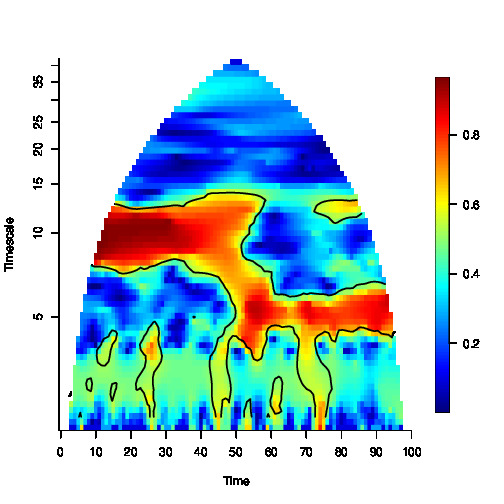
The wsyn package provides wavelet-based tools for investigating population synchrony. Population synchrony is the tendency for population densities measured in different locations to be correlated in their fluctuations through time. The basic dataset that wsyn helps analyze is one or more time series of the same variable, measured in different locations at the same times; or two or more variables so measured at the same times and locations. Tools are implemented for describing synchrony and for investigating its causes and consequences.
Some of the wavelet methods implemented here are standard and other are novel, having been developed in the course of Reuman-lab research on synchrony. See below for some of the main references.
Lawrence Sheppard was a main leader of this line of research and the methods development behind it.
- CRAN: https://cran.r-project.org/web/packages/wsyn/index.html
- Reference manual: https://cran.r-project.org/web/packages/wsyn/refman/wsyn.html
- Vignette: https://cran.r-project.org/web/packages/wsyn/vignettes/wsynvignette.pdf
- Source: https://github.com/reumandc/wsyn
Review including the wavelet approaches:
D.C. Reuman, J.A. Walter, L.W. Sheppard, V.A. Karatayev, E.S. Kadiyala, A.C. Lohmann, T.L. Anderson, N.J. Coombs, K.J. Haynes, L.M. Hallett, M.C.N. Castorani. 2025. Insights into spatial synchrony enabled by long-term data. Ecology Letters 28, e70112. doi: 10.1111/ele.70112.
Methods development (and also application):
L.W. Sheppard, E.J. Defriez, P.C. Reid, D.C. Reuman. 2019. Synchrony is more than its top-down and climatic parts: interacting Moran effects on phytoplankton in British seas. PloS Computational Biology 15, e1006744. doi: 10.1371/journal.pcbi.1006744.
L.W. Sheppard, J. Bell, R. Harrington, D.C. Reuman. 2016. Changes in large-scale climate alter spatial synchrony of aphid pests. Nature Climate Change 6, 610-613. doi: 10.1038/nclimate2881.
L.W. Sheppard, P.C. Reid, D.C. Reuman. 2017. Rapid surrogate testing of wavelet coherences. European Physical Journal, Nonlinear and Biomedical Physics 5, 1. doi: 10.1051/epjnbp/2017000.
Applications:
J.A. Walter, K.A. Emery, J.E. Dugan, D.M. Hubbard, T.W. Bell, L.W. Sheppard, V.A. Karatayev, K.C. Cavanaugh, D.C. Reuman, M.C.N. Castorani. 2024. Spatial synchrony cascades across ecosystem boundaries and up food webs via resource subsidies. Proceedings of the National Academy of Sciences 121, e2310052120. doi: 10.1073/pnas.2310052120.
M.C.N. Castorani, T.W. Bell, J.A. Walter, D.C. Reuman, K.C. Cavanaugh, L.W. Sheppard. 2022. Disturbance and nutrients synchronize kelp forests across scales through interacting Moran effects. Ecology Letters 8, 1854-1868. doi 10.1111/ele.14066.
T.L. Anderson, L.W. Sheppard, J.A. Walter, R.E. Rolley, D.C. Reuman. 2021. Synchronous effects produce cycles in deer populations and deer-vehicle collisions. Ecology Letters 24, 337-347. doi: 10.1111/ele.13650.
L.W. Sheppard, B. Mechtley, J.A. Walter, D.C. Reuman. 2020. Self-organizing cicada choruses respond to the local sound and light environment. Ecology and Evolution 10, 4471-4482. doi: 10.1002/ece3.6213.
L.P. Campbell, D.C. Reuman, J. Lutomiah, A.T. Peterson, K.J. Linthicum, S.C. Britch, A. Anyamba, R. Sang. 2019. Predicting abundances of Aedes mcintoshi, a primary rift valley fever virus mosquito vector. PLoS One 14, e0226617. doi: 10.1371/journal.pone.0226617.
J.A. Walter*, L.W. Sheppard, P.D. Venugopal, D.C. Reuman, G. Dively, J.F. Tooker, D.M. Johnson. 2019. Weather and regional crop composition variation drive spatial synchrony of lepidopteran agricultural pests. Ecological Entomology 45, 573-582. doi: 10.1111/een.12830.
T.L. Anderson, L.W. Sheppard, J.A. Walter, S.P. Hendricks, T.L. Levine, D.S. White, D.C. Reuman. 2019. The dependence of synchrony on timescale and geography in freshwater plankton. Limnology and Oceanography 64, 483-502. doi: 10.1002/lno.11054.
People
Lawrence Sheppard, Tom Anderson, Jon Walter, Lei Zhao, Dan Reuman