Synchrony of marine fish populations
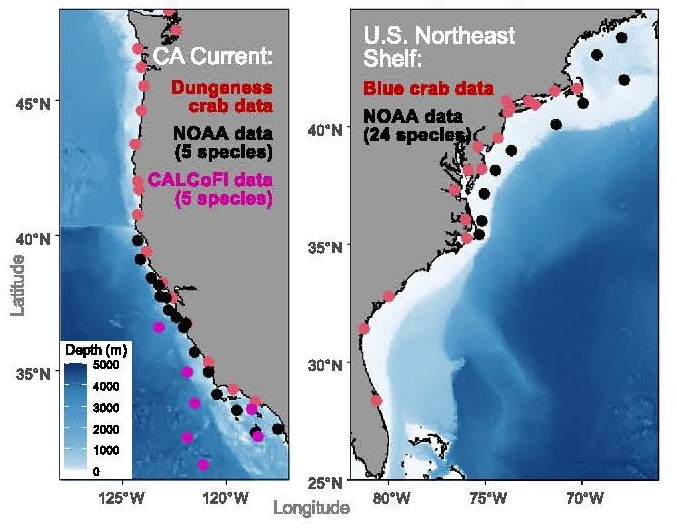
Some of our earlier work contributed to the current understanding that changes in synchrony are another of the widespread ecological impacts of climate change. Former Reuman lab postdoc Vadim Karatayev (now on the faculty at the University of Maryland) took this topic to the next level by studying, and modelling using empirical dynamic models, 36 exploited marine fish and invertebrate species up and down both coasts of North America. Population synchrony tends to be substantially weaker than the synchrony of the environmental drivers that produce it. The potential for future climate change to alter synchrony depends on the mechanisms that produce this weakening effect. Vadim found that spatial heterogeneity in population dynamics is what weakens synchrony on the West Coast, whereas gradients in average environmental conditions were more important for weakening East Coast synchrony. These differences suggested a greater potential for future climate change to increase synchrony on the East compared to the West Coast, possibly reducing metapopulation resilience there.
V.A. Karatayev, S.B. Munch, T.L. Rogers, D.C. Reuman. 2024. Climate change could amplify weak synchrony in large marine ecosystems. Proceedings of the National Academy of Sciences 122, e2404155121. doi: 10.1073/pnas.2404155121.
People: Vadim Karatayev, Dan Reuman