A theory explaining how drivers of spatial synchrony interact
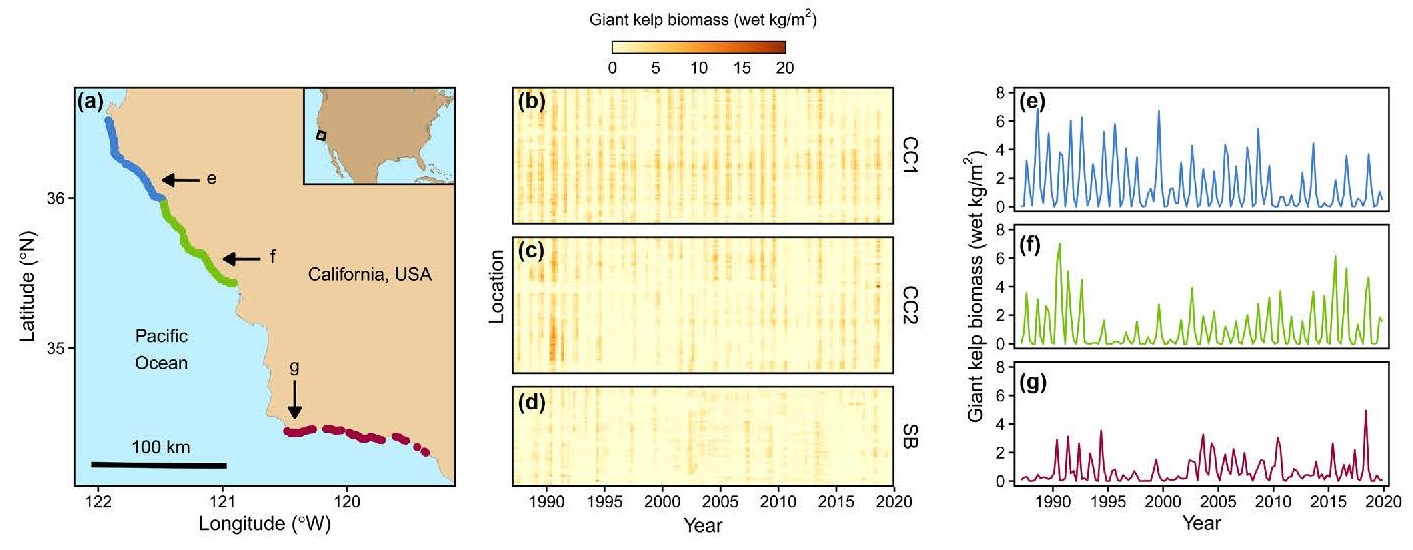
Prior work from the lab (Sheppard et al., 2019; Castorani et al., 2022), led by Lawrence Sheppard and Max Castorani, showed that distinct environmental drivers of synchrony can interact in unexpected ways. We developed a thorough timescale-specific theory of Moran interactions, tested and validated with data from kelp forests.
M.C.N. Castorani, T.W. Bell, J.A. Walter, D.C. Reuman, K.C. Cavanaugh, L.W. Sheppard. 2022. Disturbance and nutrients synchronize kelp forests across scales through interacting Moran effects. Ecology Letters 8, 1854-1868. doi 10.1111/ele.14066.
D.C. Reuman, M.C.N. Castorani, K.C. Cavanaugh, L.W. Sheppard, J.A. Walter, T.W. Bell. 2023. How environmental drivers of spatial synchrony interact. Ecography 10, e06795. doi: 10.1111/ecog.06795.
L.W. Sheppard, E.J. Defriez, P.C. Reid, D.C. Reuman. 2019. Synchrony is more than its top-down and climatic parts: interacting Moran effects on phytoplankton in British seas. PloS Computational Biology 15, e1006744. doi: 10.1371/journal.pcbi.1006744.
People: Lawrence Sheppard, Jon Walter, Dan Reuman