Asymmetric tail associations in ecology
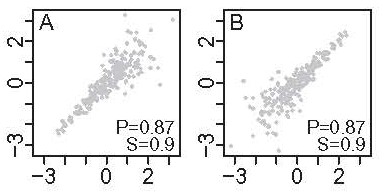
We discovered in the course of our other work that a simple statistical idea has far-reaching implications in ecology. When two variables are positively related in ecology, that association is usually described very simply with a single number, typically a correlation coefficient (Pearson, Spearman). But in fact the non-marginal information content of a joint distribution is a much higher dimensional object. A useful second dimension turns out to be the degree of asymmetry of the association in the tails. These ideas turn out to be far reaching, influencing phenomena as diverse as the 2008 financial crisis, extinction risk, spatial and community synchrony, Taylor’s law, and ecological stability. We have studied the nature, causes, and ecological consequences of asymmetries of tail associations in ecological variables over a period of several years, with an ongoing interest.
J.A. Walter, M.C.N. Castorani, T.W. Bell, L.W. Sheppard, K.C. Cavanaugh, D.C. Reuman. 2022. Tail-dependent spatial synchrony arises from nonlinear driver-response relationships. Ecology Letters 25, 1189-1201. doi: 10.1111/ele.13991.
S. Ghosh, K.L. Cottingham, D.C. Reuman. 2021. Species relationships in the extremes and their influence on community stability. Philosophical Transactions of the Royal Society B 376, 20200343. doi: 10.1098/rstb.2020.0343.
S. Ghosh, L.W. Sheppard, P.C. Reid, D.C. Reuman. 2020. A new approach to interspecific synchrony in population ecology using tail association. Ecology and Evolution 10, 12764-12776. doi: 10.1002/ece3.6732.
S. Ghosh, L.W. Sheppard, D.C. Reuman. 2020. Tail associations in ecological variables and their impact on extinction risk. Ecosphere 11, e03132. doi: 10.1002/ecs2.3132.
S. Ghosh, L.W. Sheppard, M.T. Holder, T.E. Loecke, P.C. Reid, J.D. Bever, D.C. Reuman. 2020. Copulas and their potential for ecology. Advances in Ecological Research 62, 409-468. doi: 10.1016/bs.aecr.2020.01.003.
People: Shyamolina Ghosh, Lawrence Sheppard, Jon Walter, Dan Reuman